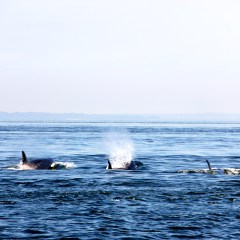
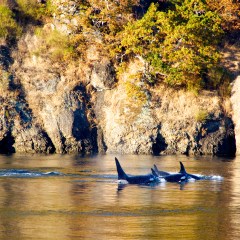
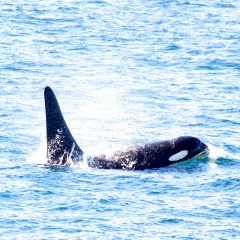
 So it’s taken a while, but I am finally giving in to the gentle—well, some of it not so gentle—prodding from my substantial fan base (thanks, Wilf…Lucas…Jenn) and jumping back on the blogging wagon. And really, I shouldn’t have any excuses. I finished my thesis in May, and defended it (successfully) at the end of July. So I am now a MSc.-degree-holding fisheries scientist. Without a job. But that’s cool. It means I have a ridiculous amount of time to blog again. I did spend a few months over the summer working as a naturalist with one of Vancouver’s local whale watching companies. It was pretty epic; the perfect antithesis to working at a desk all day if ever there was one. And, while the natural highlight of the trips was the whales, I have to admit, the intelligence of the human race was a close second. Some of the questions the boat staff fielded this year included: “Do you sell fish so we can feed the whales?”, “Do they ever swim under the islands?”, “How do you know they’ll come back to the surface?”, “Are they extincted?”, “Where will we see the whales? Like, could they be anywhere or do you guys keep them in certain places?”. Those were all from people over the age of 30. Amazing. I try not to judge too hard though and just put it down to the excitement of the moment. And, fortunately, I did meet some wonderful people (from all over the world) while working on the boat. And, when I wasn’t talking about whales, this job also gave me a good chance to incorporate a little of my own work and chat with our guests about fisheries and sustainable seafood initiatives. I found a lot of people were really eager to learn more, and were curious about what I had to say and how they could make smarter seafood choices. So that was pretty cool.

 Typically, when I start writing about the situation regarding the decline of bluefin tuna*—which has been primarily driven by demand from the Japanese sashimi market since the late 1970s—my go-to introductory sentences include the words “luxury”, “expensive”, and “wealthy consumer”. The use of this terminology stemmed from a personal belief that bluefin was part of the upper echelon of gastronomic extravagance: the marine equivalent to a Kobe steak or Périgord truffles. Thus, you can imagine my complete surprise when I was in Tokyo this past month and saw it on the menu of every seafood restaurant in which I ate, or passed on the street. Literally, every single one—from 49th floor fine dining establishments, to curbside take-out lunch stands. I honestly could not believe that this fish was still so ubiquitous and, in many cases, inexpensive, when there is so much international pressure to reduce catches and allow for populations to recover.
 Just so we’re all on the same page, I think it’s important to say right from the get-go that I believe in a strong calibre gradient when it comes to literature. As such, I don’t really consider something that’s featured as a must-read in TigerBeat to be in the same category as the likes of Dumas, Tolkein, or the Brontë sisters. And while I know I’m no Jane Austen, I do feel safe in saying that M.L. Stedman’s
  salt heart | wet coast