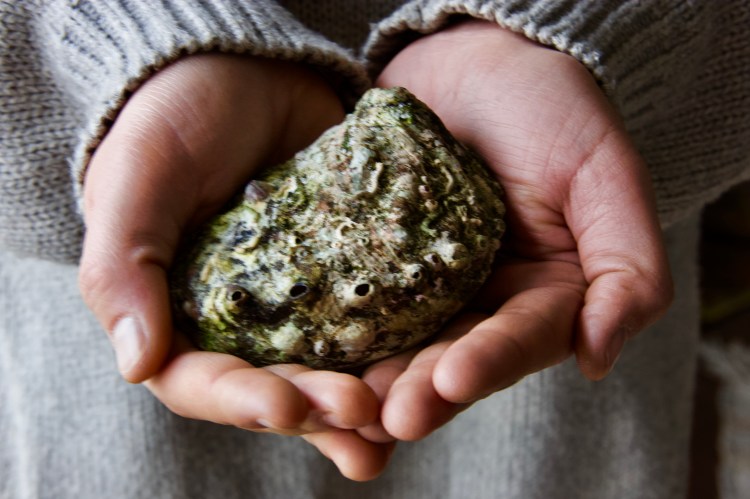
The abalone was trying to escape. And, for the last few minutes, I had been formulating a plan to assist it. I lifted the ceramic lid again. The mollusc was still firmly attached but its strong muscular foot was slowly curling toward the rim. Anthropomorphizing is a tricky business, so I hesitate to say it knew it was in mortal peril. Still, it was clear that it did not want to be in that dish and, by extension, part of my meal. That made two of us. I looked around the room at my companions. All were engrossed in the contents of their own platters, eliciting the kind of focus required for a dining experience that had thus far been a bucket list of foreign tastes: shark heart carpaccio, sea urchin roe, greenling sashimi, a gelatinous cube of anglerfish, and a heaping portion of raw cod testes. Would they notice if I slipped the abalone into the folds of my yukata robe? Would they care? A Japanese woman in a floral kimono re-entered the room. Our server. She crouched near my platter with a smile and lit the fuel canister under the dish containing the abalone. If we were going to make a break for it, it was now or never.
 So it’s taken a while, but I am finally giving in to the gentle—well, some of it not so gentle—prodding from my substantial fan base (thanks, Wilf…Lucas…Jenn) and jumping back on the blogging wagon. And really, I shouldn’t have any excuses. I finished


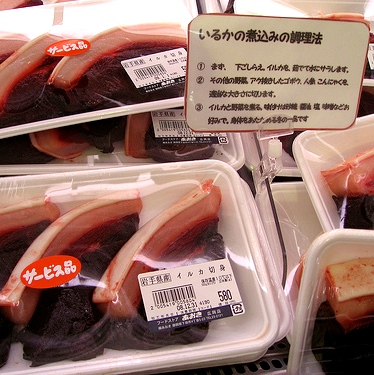 My facebook and Twitter feeds have been aflutter this week with news and comments about the annual Taiji dolphin hunt. And, since this topic was another point of contention between Wilf and I (despite what it must sound like, we actually really do like each other), I may find myself hungry and homeless after writing this post. But I think it’s something that needs to be discussed. (Just a warning, there are some fairly graphic pics in this post, so consider averting sensitive eyes.)
 Wilf and I get into a solid argument at least once a day. Usually it’s small stuff, like who cooks most or does the laundry more often. These typically result in one of us giving in, sitting on the couch pouting for 10-15 minutes, and then forgetting it ever happened…until the next time. But sometimes we get into some really good disputes. Take last night for example. We argued for over an hour about sour cream. Well, I guess the sour cream was the catalyst to larger issues, but still, it was amusing. And so, while I will be posting on our recent trip at some point (we had a wonderful time, but it was strange to hear “White Christmas” playing when it was 30+ °C outside), I’m going to make my first entry of the new year about one of our other arguments this week. Well, no, it’s more about traditions. Well, actually it’s mostly about tuna. (Yeah, clearly not much has changed.)
 Typically, when I start writing about the situation regarding the decline of bluefin tuna*—which has been primarily driven by demand from the Japanese sashimi market since the late 1970s—my go-to introductory sentences include the words “luxury”, “expensive”, and “wealthy consumer”. The use of this terminology stemmed from a personal belief that bluefin was part of the upper echelon of gastronomic extravagance: the marine equivalent to a Kobe steak or Périgord truffles. Thus, you can imagine my complete surprise when I was in Tokyo this past month and saw it on the menu of every seafood restaurant in which I ate, or passed on the street. Literally, every single one—from 49th floor fine dining establishments, to curbside take-out lunch stands. I honestly could not believe that this fish was still so ubiquitous and, in many cases, inexpensive, when there is so much international pressure to reduce catches and allow for populations to recover.
 salt heart | wet coast